

PSL Scale Wiki / Eye anatomy
What are
hooded eyes?
A closer look at the upper eyelid: what the fold means, how to recognize it, and how to work with it.
Hooded eyes meaning: the fold, not the opening
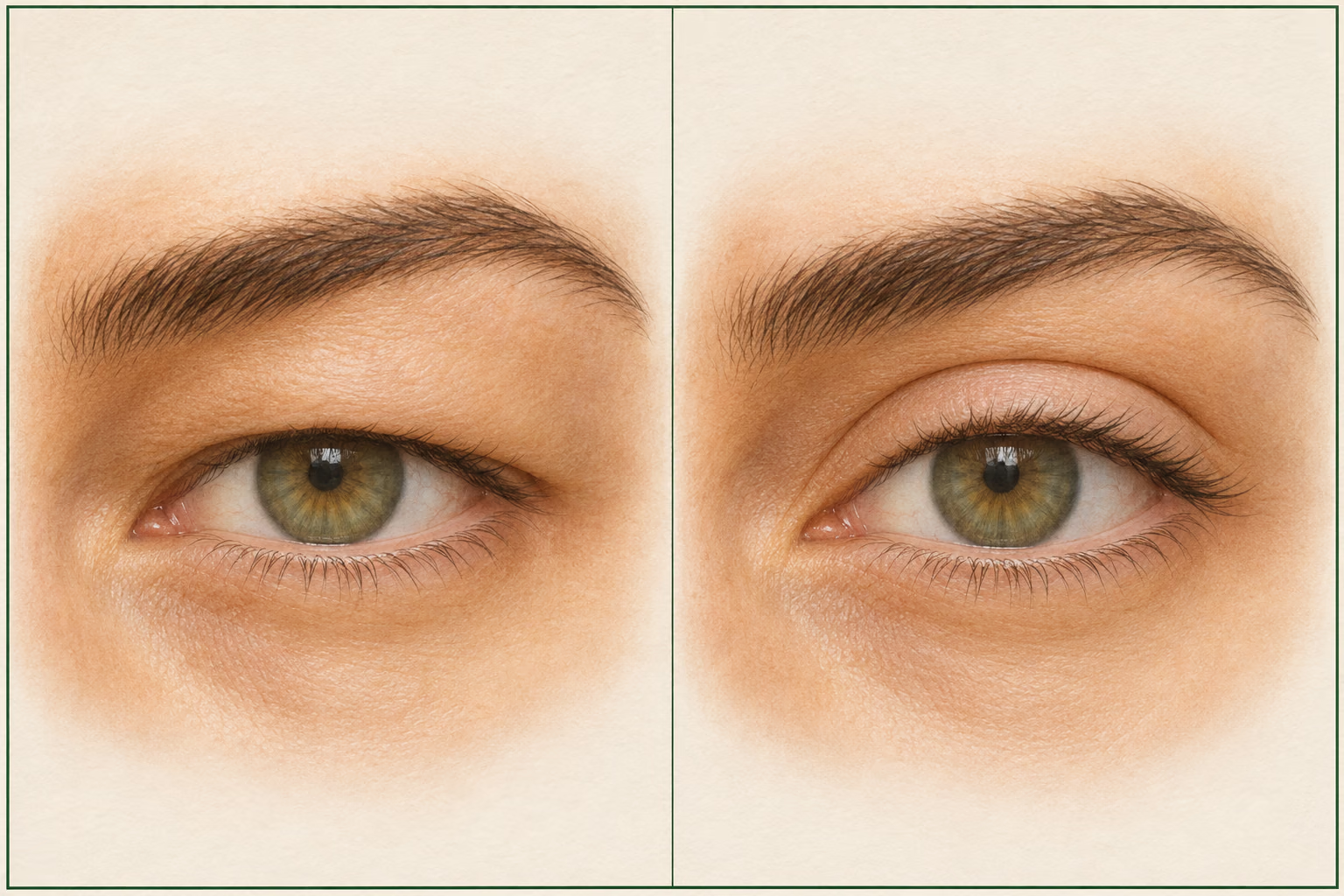
Think of the upper eyelid as two visible areas: the mobile lid near the lashes and the skin leading toward the eyebrow. A crease separates them. With hooded eyes, the skin above that crease drapes over it, so less of the mobile lid is visible in a relaxed, forward gaze.
That description is about the skin fold. An almond-shaped eye can also have hooding, and eye-corner tilt is a separate observation. A small strip of visible lid does not tell you the depth of the eye socket or how well the eyelid muscles work.
For a basic definition and the terminology used here, see All About Vision’s overview. The comparison below focuses on what you can actually observe.
Hooded eyes vs non hooded eyes
Compare the upper lids with the eyes open comfortably and the eyebrows at rest. With non hooded eyes, more of the mobile lid and crease is usually exposed. With hooding, the overlying skin covers more of that space. Coverage falls along a spectrum; it is not a precise two-category measurement.
| What to look at | Hooded eyelids | Non-hooded eyelids |
|---|---|---|
| Upper crease | Partly or largely concealed by skin above it. | Generally easier to see with the eye open. |
| Mobile lid | Less visible space above the lashes. | More visible space above the lashes. |
| Shadow placement | Color may disappear into the fold when the eye opens. | Color on the lid is often easier to see. |
| Liner placement | A thick line can occupy most of the visible lid. | There may be more room above the lash line. |
A hidden crease is not the same as no crease. Monolids lack a clearly defined upper crease; a hood can conceal one that exists. Ptosis is different again: the eyelid margin itself sits lower over the eye. These features can overlap, and a photograph cannot establish a medical diagnosis.
How to tell if you have hooded eyes
Use a mirror at eye level in soft, even light. The useful question is how the skin rests when you are looking ahead, rather than how much lid you can reveal by changing your expression.
- Relax your forehead. Look straight ahead without lifting your brows, squinting or opening your eyes unusually wide.
- Find the crease. Look for the fold above the upper lashes. Notice whether skin overlaps it at the center, outer corner or along most of the lid.
- Look down briefly, then ahead. A crease that becomes clearer as you look down may be concealed again in your resting gaze.
- Observe each side separately. Record the part of the lid that is covered rather than forcing both eyes into an identical label.
You can use our free True Mirror to compare a relaxed camera frame in mirrored and non-mirrored orientations. Keep the lens at eye level. The tool changes orientation; it does not diagnose hooded eyes or remove camera perspective.
Why hooded eyes appear: genetics and aging
Some people have this lid shape from a young age, while others notice it becoming more apparent over time. Inherited facial anatomy and age-related skin changes both contribute to the appearance. The fold can also look different when the brow is raised or the gaze changes.
To make a useful visual comparison, keep the lighting, expression and camera height consistent. Compare a relaxed photograph with another relaxed photograph. A raised-brow selfie and a downward-looking portrait answer different questions about visible lid space.
A long-standing fold is different from a newly drooping eyelid. Changes in vision or a sudden change in eyelid position deserve medical attention rather than another eye-shape comparison.
Eyeliner for hooded eyes: start with the open eye
A line that looks neat on a closed lid can disappear or bend across a fold once the eye opens. The practical starting point for eyeliner for hooded eyes is a relaxed, forward gaze and a small amount of product.
- Keep the lash line fine. Build a narrow line just above the upper lashes. Check how much lid is still visible before adding thickness.
- Sketch the wing with your eyes open. Mark a short outer flick where you can see it in your resting gaze. Then gently lower the lid to connect the line.
- Work around your fold. If it crosses the wing, a small stepped or “bat-wing” connection may look continuous from the front even though it looks angular on a closed lid.
- Check after blinking. Let the product set according to its directions, then look for transfer. Adjust the line or formula if it stamps onto the skin above.
Treat hooded eyes eyeliner as a placement exercise. Start short and thin, inspect it straight ahead, and change one part at a time. There is no single wing angle that suits every fold.
Eyeshadow for hooded eyes: keep the color in view
Plan eyeshadow for hooded eyes while looking ahead. If all the color sits on the mobile lid, the skin fold may hide it. Blend a little of the transition shade above the resting fold so it remains visible, then soften the edge.
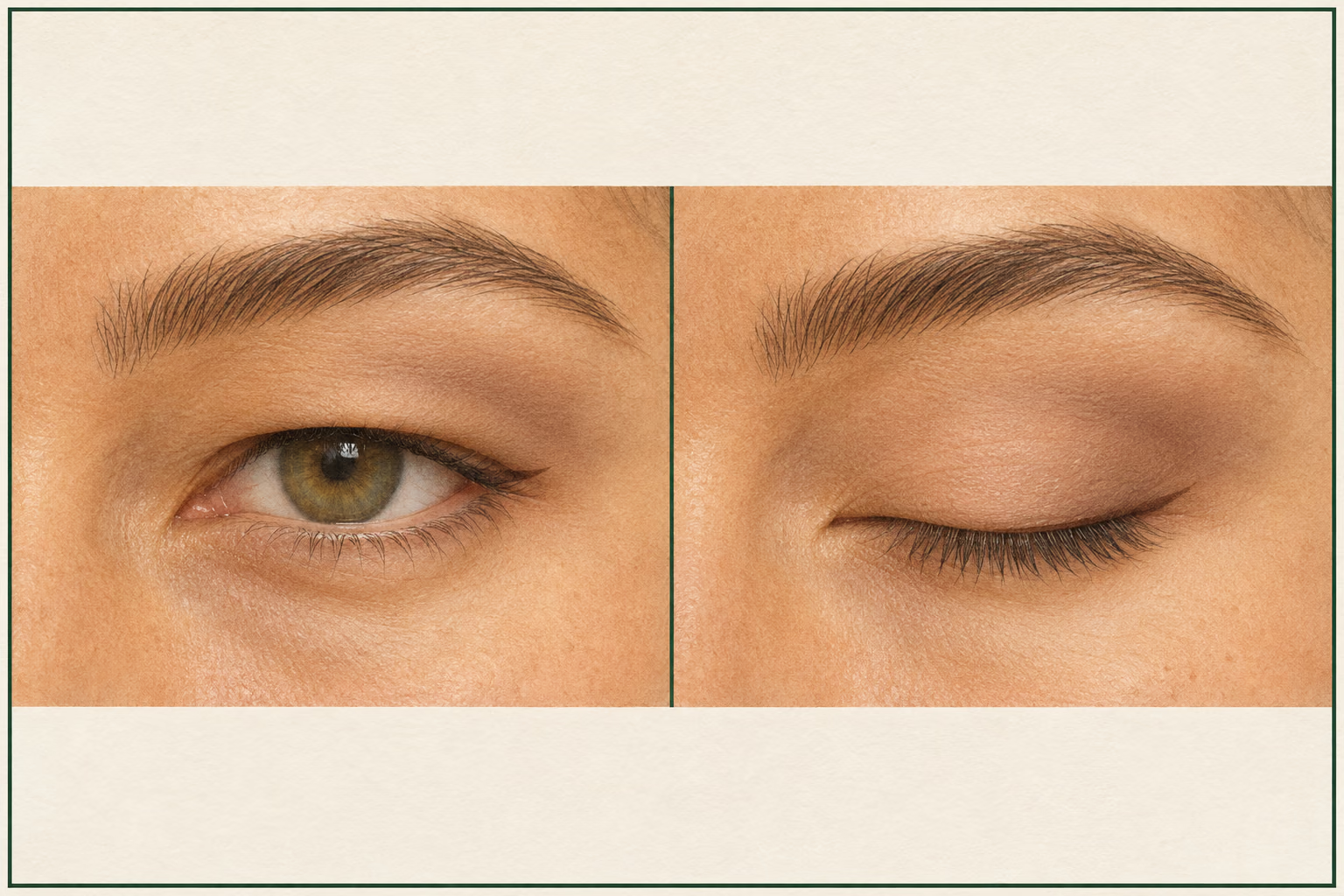
For cream formulas, begin with a small amount and blend before the product sets. A fingertip can place the color; a small brush gives more control near an edge. Trinny London’s cream-shadow guide is a useful starting reference. A cream is an option, not a guarantee against creasing.
For a simple look, try a soft transition color above the fold, a little depth toward the outer third, and a lighter touch on the visible inner lid. Check the result in the expression you normally wear. Shimmer is a styling choice; choose its placement by what you want to highlight.
The goal of makeup for hooded eyes can be as small as making a favorite color visible. You can follow the fold, emphasize the lash line, or choose no eye makeup at all.
A closer look, with the right tools
Separate the fold from the other features around it. These free tools answer different visual questions, so use the result that matches what you want to observe.
True Mirror
Compare both orientations of one camera frame or photo. Useful for observing the resting fold and checking makeup placement.
Eye Shape Detector
Explore eye-opening proportions and corner direction. It cannot classify hooding or monolids because it does not locate the crease.
Canthal Tilt Calculator
Estimate the direction between the inner and outer corners. Tilt is a different measurement from upper-eyelid coverage.
For more context, read the hunter eyes guide. Hooding alone does not establish that broader appearance label, and no tool here assesses eyelid health.
Do hooded eyes need treatment?
A stable shape without symptoms usually needs no treatment. If excess upper-lid skin gradually interferes with your view, an eye clinician can assess the skin, brow position, eyelid function and visual field.
Upper blepharoplasty removes excess eyelid skin and may be considered for functional or cosmetic reasons. Southeastern Plastic Surgery’s overview describes that approach. It is an individual treatment decision, rather than a default next step for an eye shape.
Mayo Clinic’s guidance explains the assessment and risks, including dry eyes, difficulty closing the lids, bleeding and scarring. Skin-removal surgery and treatment for a drooping lid margin address different problems. A qualified clinician can explain which, if either, applies.
Hooded eyes FAQ
What are hooded eyes, in simple terms?
Hooded eyes have an upper skin fold that overlaps the eyelid crease, hiding some of the mobile lid when the eyes are open. The amount of coverage varies. The term describes a normal appearance and does not, by itself, mean that an eyelid is drooping over the pupil.
Can hooded eyes also be almond-shaped?
Yes. Almond describes the outline of the eye opening; hooding describes the upper skin fold. Those observations can coexist. Corner direction is another separate feature, so an eye can also look upturned, level or downturned.
What is the difference between hooded eyes vs non hooded eyes?
The difference is how much of the upper lid and crease remains visible with a relaxed, forward gaze. Hooding covers more of that area. Non hooded eyes generally show more mobile lid. Neither label describes how well someone sees or how attractive they are.
Are hooded eyes the same as monolids?
No. A monolid has no clearly defined upper-eyelid crease. Hooding describes skin overlapping the crease area, which can make an existing crease difficult to see. If you cannot see a crease in a photograph, that alone does not distinguish the two.
What is a good starting point for hooded eyes eyeliner?
Begin with a fine line close to the upper lashes. Sketch a short outer wing while looking straight ahead with the brow relaxed, then check it after a few natural blinks. Adjust the placement to your own fold rather than copying a wing drawn on a closed eye.
Is cream eyeshadow suitable for hooded eyes?
It can be. A thin, well-blended layer is a useful starting point. Check that a little of the color remains visible above the fold with your eyes open, and let the formula set as directed. Wear and transfer depend on the product, preparation and your skin.
What is hooded eyes makeup?
It is makeup placement adapted to an overlapping upper-lid fold. For everyday makeup for hooded eyes, that might mean keeping liner narrow and blending some shadow above the resting fold. The aim is to control what stays visible when your eyes are open, without needing to change their shape.
Can the Eye Shape Detector tell whether my lids are hooded?
No. PSL Scale’s free Eye Shape Detector estimates the eye opening and corner direction from facial landmarks. Its model does not locate the eyelid crease, so it cannot classify hooding or monolids. Use a relaxed mirror view to observe the fold; ask an eye clinician about changes or symptoms.
Do hooded eyes need treatment?
A stable eyelid shape without symptoms usually needs no treatment. If skin gradually blocks your vision, arrange an eye examination. A suddenly drooping eyelid needs emergency assessment. Cosmetic decisions should follow an individual discussion of goals, alternatives and risks with a qualified clinician.
Sources & further reading
An original editorial guide informed by the references below. Beauty and surgical-practice articles provide their respective perspectives; clinical sources support the health information. This article has not been medically reviewed.
- All About Vision: Hooded eyes
Background on eyelid appearance, inherited traits and terminology.
- Trinny London: How to apply eyeshadow to hooded eyes
A beauty-brand perspective on cream shadow and working with a concealed crease.
- Southeastern Plastic Surgery: What is the best treatment for hooded eyelids & other eyelid issues?
A surgical-practice overview of blepharoplasty; a treatment reference rather than a reason to change a normal feature.
- Mayo Clinic: Blepharoplasty
Clinical context for excess skin, visual-field concerns, assessment and surgical risks.
- North American Neuro-Ophthalmology Society: Droopy eyelid (ptosis) — patient information (PDF)
The distinction between skin hooding and eyelid droop, including sudden-onset symptoms.