
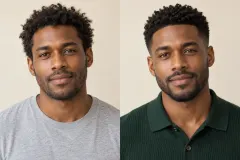


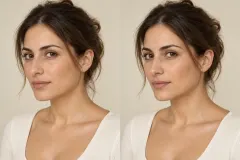
MEDIAPIPE FACE SHAPE DETECTOR

Face shape detector

Upload a clear front-facing photo. MediaPipe measures your visible face contour first, deterministic geometry ranks six common face-shape families, and AI turns the result into practical hairstyle, glasses, makeup, and styling ideas.

10 credits per completed reportGeometry before AINothing savedDownloadable PNG

Upload a front-facing portrait

JPEG, PNG, or WebP up to 10 MB

Private by design

MediaPipe detects landmarks in your browser. The photo and measurements are used only for this single AI request. We do not save the photo, landmarks, classification, or report—download the result if you want to keep it.

EXAMPLE REPORT

Preview the result before uploading

The finished report shows the measured contour, the closest face-shape families, and practical styling ideas in one downloadable layout.

YOUR FACE SHAPE RESULT

Personal face-shape styling report

Portrait with face contour measurement lines

Primary match

Oval

72% geometric confidence

This example is primarily oval: face length is visibly greater than cheekbone width, while the forehead and jaw taper gradually rather than forming sharp corners.

Why this shape was selected

The length-to-width ratio sits near the oval prototype. Cheekbones are the widest measured area, the forehead remains close in width, and both jaw measurements narrow progressively. Oblong is the closest secondary match, illustrating that face-shape categories often blend.

Face length ÷ cheekbone width

1.420

Forehead width ÷ cheekbone width

0.910

Jaw width ÷ cheekbone width

0.780

Lower-jaw width ÷ cheekbone width

0.570

Oval46.2%
Oblong24.8%
Heart13.4%

Personalized styling ideas

Hairstyles

  • Try soft face-framing layers that begin near the cheekbones to preserve the balanced outline.
  • A center or gentle off-center part can work well without adding unnecessary height.
  • Medium texture and side volume can add movement while keeping the contour visible.

Glasses

  • Frames slightly wider than the cheekbones can maintain the face's balanced proportions.
  • Angular or softly geometric frames can add structure without overwhelming the jaw.
  • Choose a brow line that follows the natural brows and a bridge that keeps the eyes centered.

Optional makeup

  • If desired, place blush softly across the upper cheeks rather than pulling it too far downward.
  • A restrained highlight at the cheekbones can emphasize the naturally balanced mid-face.
  • Keep contour subtle along the hairline and jaw so the existing taper stays visible.

Styling and photo tips

  • Show the forehead and jawline when comparing future photos.
  • Avoid a very close wide-angle camera because it can distort face width.
  • Use the secondary match as an alternative styling reference when an idea feels more natural.

This result exists only in your browser after generation. We do not add it to your history or store your photo, landmarks, classification, or AI report.

pslscale.com

HOW IT WORKS

Landmarks first, AI advice second

The classifier and the recommendation writer have separate jobs, so the AI cannot silently change the measured face shape.

Detect 478 landmarks

MediaPipe runs in the browser and locates the forehead, cheekbones, jaw, chin, eyes, nose, and other stable reference points.

Calculate the face shape

Four contour ratios compare face length and the widths of the forehead, cheekbones, jaw, and lower jaw against six broad shape prototypes.

Generate useful advice

AI receives the fixed classification and turns it into optional hairstyle, glasses, makeup, styling, and photography suggestions.

SIX SHAPE FAMILIES

Face shapes are a spectrum

Most people sit between categories. The report shows ranked matches instead of pretending every face fits one perfect label.

Oval

Longer than wide, with cheekbones usually wider than a gradually tapering jaw.

Round

Face length and width are closer, with a softer jaw transition and fuller side contour.

Square

Length and width are closer, while forehead, cheekbones, and jaw remain relatively similar in width.

Heart

A relatively broad upper face narrows more strongly through the jaw toward the chin.

Oblong

A visibly longer contour with forehead, cheekbone, and jaw widths that remain comparatively balanced.

Diamond

Cheekbones are the widest zone, with both the forehead and jaw tapering more clearly.

PHOTO GUIDE

Make the contour measurable

A face-shape detector reads a two-dimensional photo, so a neutral and unobstructed portrait gives the most repeatable result.

Keep the camera at eye level and look straight ahead.
Use even front lighting without deep shadows on either side.
Pull hair away from the forehead, cheekbones, and jaw.
Keep a relaxed expression with the mouth naturally closed.
Avoid beauty filters, portrait reshaping, and very close wide-angle shots.
Retest with the same camera distance if you want to compare results.

Hairstyle detail

Get ideas for length, layers, volume placement, fringe, parting, texture, and optional facial-hair balance.

Glasses geometry

Explore frame width, angularity, brow line, bridge position, and shapes that complement the measured contour.

Optional makeup

Receive inclusive placement ideas for blush, contour, highlight, brows, and eye emphasis—never requirements.

FAQ

Face Shape Detector questions

Direct answers about accuracy, privacy, credits, downloads, and recommendation boundaries.

How does the Face Shape Detector work?

MediaPipe detects facial landmarks in your browser. The server validates the portrait and calculates four contour ratios before AI writes recommendations from that fixed result.

Is AI deciding my face shape?

No. Deterministic geometry selects and ranks the face-shape families. AI explains that result and creates hairstyle, glasses, makeup, and styling ideas.

How accurate is a face-shape result?

It is an estimate from one two-dimensional photo. Lens distance, head angle, expression, hair coverage, and landmark uncertainty can change the result, and mixed shapes are common.

Do you save my photo or result?

No. The photo and measurements are used for one report request, then discarded. The classification and report are not added to history, so download the PNG if you want to keep it.

When are credits charged?

A completed report costs 10 credits. Invalid photos, failed face detection, quality failures, or AI errors do not produce a report and do not charge credits.

Can I download the report?

Yes. The browser creates a high-resolution PNG containing the annotated image, measurements, ranked matches, and recommendations. Downloading again does not use credits.

Are the makeup recommendations required?

No. They are optional creative ideas. The report is designed to work for users who wear makeup and users who do not.

Is this medical or cosmetic-procedure advice?

No. It is a styling and photography tool, not a diagnosis, attractiveness rating, or recommendation for surgery or other irreversible changes.

Find your face-shape family

Use 10 credits for transparent MediaPipe contour measurements and a private, downloadable styling report.