


The useful answer
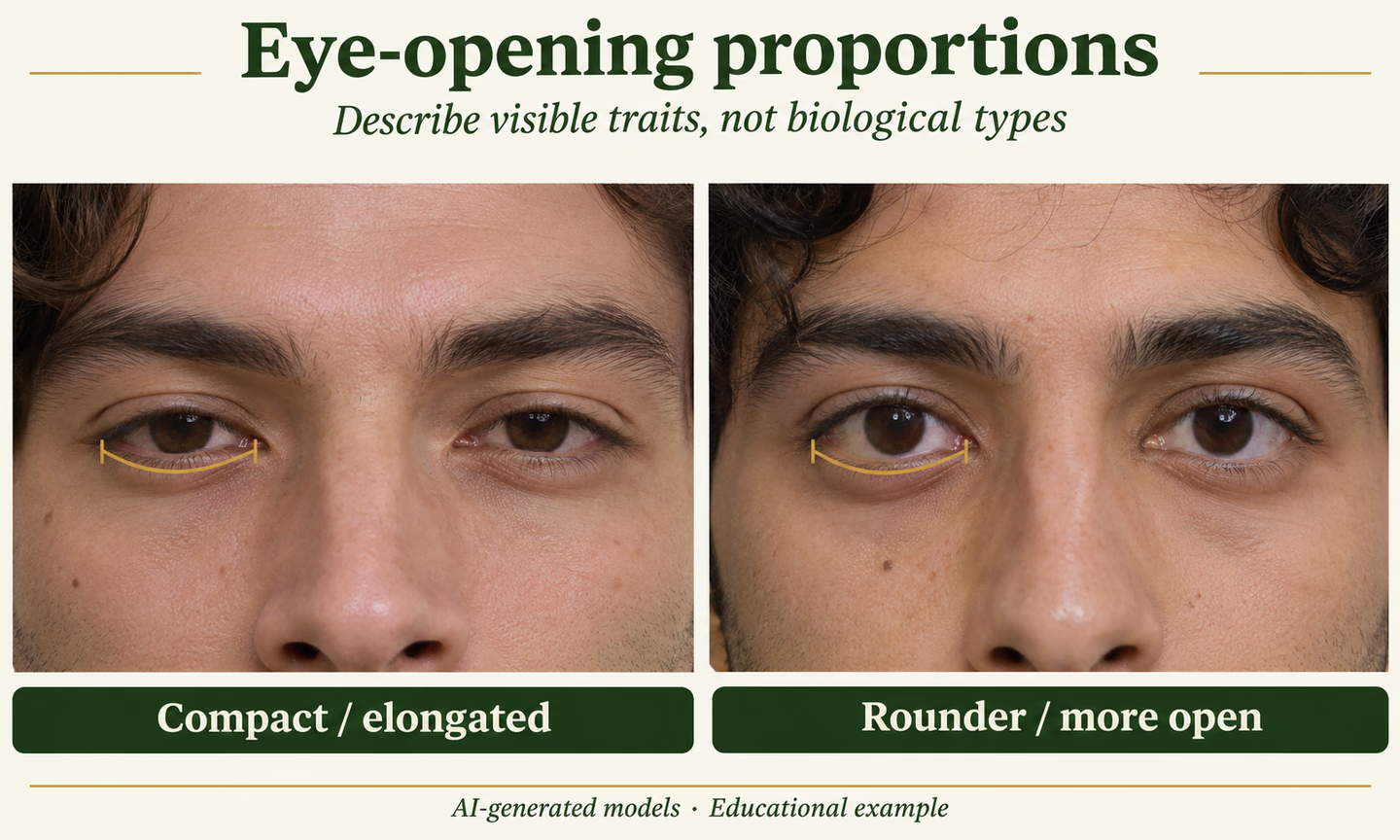
Hunter eyes usually refers to a compact, elongated-looking eye area; prey eyes usually refers to a rounder, more open appearance. These are internet descriptions on a continuum, not medical types or evidence about a person’s character.
01 / FIELD NOTES
Hunter vs prey eyes, feature by feature
A useful comparison names the feature being compared. Two people with similar opening widths may have different opening heights, crease visibility and brow positions. Calling one hunter and the other prey compresses all those differences into two loaded words.
The AI-generated photographic examples illustrate differences in visible opening shape. The contour marks are teaching aids, not standardized measurements. Neither example is a diagnosis, and neither predicts how appealing an entire face looks.
| Feature | Often called “hunter” | Often called “prey” |
|---|---|---|
| Opening | More elongated or compact | Rounder or more open |
| Upper lid | Less visible lid skin | More visible lid skin |
| Lower lid | Relatively straight appearance | More curved or open appearance |
| Brow frame | Visually close or shaded | More visible brow-to-eye space |
| Corner tilt | Often level or upward | Can be upward, level or downward |
| Meaning | Informal appearance shorthand | Informal appearance shorthand |
02 / FIELD NOTES
Why corner tilt cannot settle the comparison
The line between the inner and outer corner describes the direction of the opening. It does not tell you how tall that opening is, how much lid skin shows, or where the brow sits. A positive angle can accompany a round eye; level corners can accompany an elongated opening.
For the same reason, there is no universal “hunter angle.” Read the canthal tilt guide and compare the corner axis separately from the other eye-area traits. If the head is rolled or one corner is obscured, be cautious about a photo measurement.
03 / FIELD NOTES
A relaxed face and a squint can tell different stories
A wide-eyed expression increases the visible opening; a squint reduces it. Brow raising also changes the frame. Strong overhead light can create shadows that are absent in soft front light. None of those immediate changes establishes a new resting eye type.
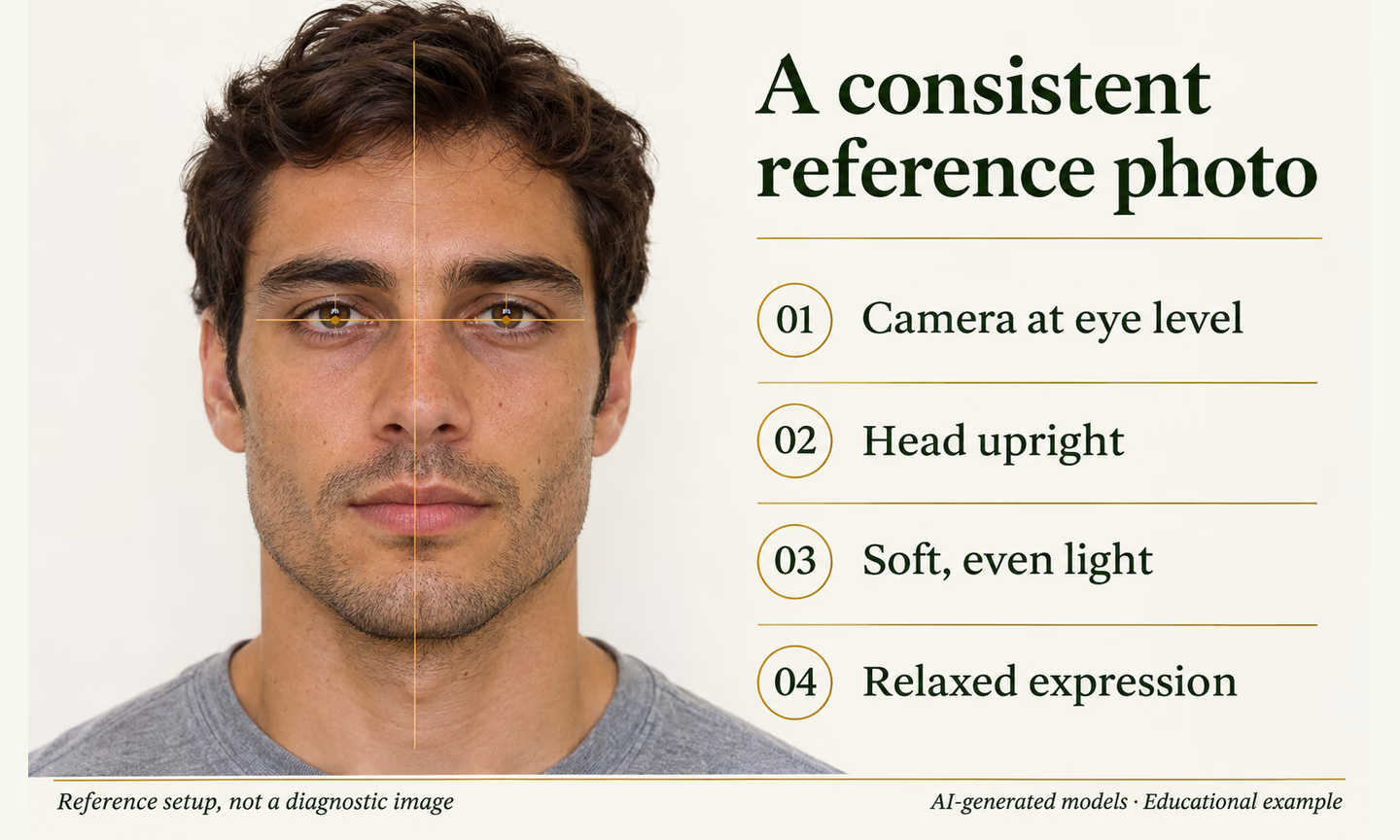
When looking at a comparison online, check whether the two images use the same head angle, distance, light and expression. A before-and-after that changes all four is showing a presentation difference with several possible explanations. Our self-check guide gives a repeatable reference setup.
04 / FIELD NOTES
Can hunter eyes be big, almond-shaped or hooded?
Yes, those words can describe different dimensions. “Big” might mean a large-looking iris, a wide opening or a large overall eye area. “Almond” describes an opening outline. “Hooded” describes skin overlapping the crease. They are not mutually exclusive categories.
Rather than asking whether big eyes disqualify you, name what you see: a wide opening with low height, for example, or a visible crease beneath a low brow. The eye-shape and variation guide explains why monolids, hooding and opening shape should be read separately.
05 / FIELD NOTES
What about lions, cats and the hunter/prey analogy?
Comparisons involving a lion or a cat are visual analogies used in posts and memes. They do not establish two human eye types. Human eyelid geometry cannot tell you whether someone is dominant, timid, dangerous or suited to a particular role.
If the terminology helps you describe a styling reference, keep it descriptive. If it makes you treat ordinary eye variation as a defect, use the specific neutral terms instead: opening proportions, lid fold, brow position and corner tilt.
A FEW MORE ANSWERS
Frequently asked questions
Is prey eyes vs hunter eyes the same comparison reversed?
Yes. The word order changes, but people are generally comparing the same informal descriptions. There is no separate reverse classification.
Which is more attractive?
There is no universal answer from these labels. A single feature does not summarize a face, and individual preferences and presentation differ.
Can prey eyes turn into hunter eyes?
Expression and styling can alter the appearance. They do not prove a structural conversion. A lasting anatomical claim needs more than a squinting after-photo.
Explore your own eye area.
Use a clear, relaxed photograph. Read the result as a photo-based description, with the limits of the image in mind.
Try the Hunter Eyes tool