



The useful answer
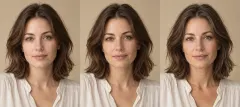
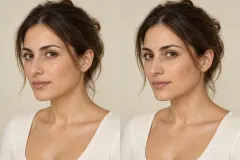
A squint temporarily narrows the visible opening while you hold it. That is an expression change, not evidence of a permanent hunter-eye structure. Clinical eye exercises for specific vision problems are a separate topic and do not validate cosmetic reshaping routines.
01 / FIELD NOTES
What actually happens during a hunter eyes exercise?
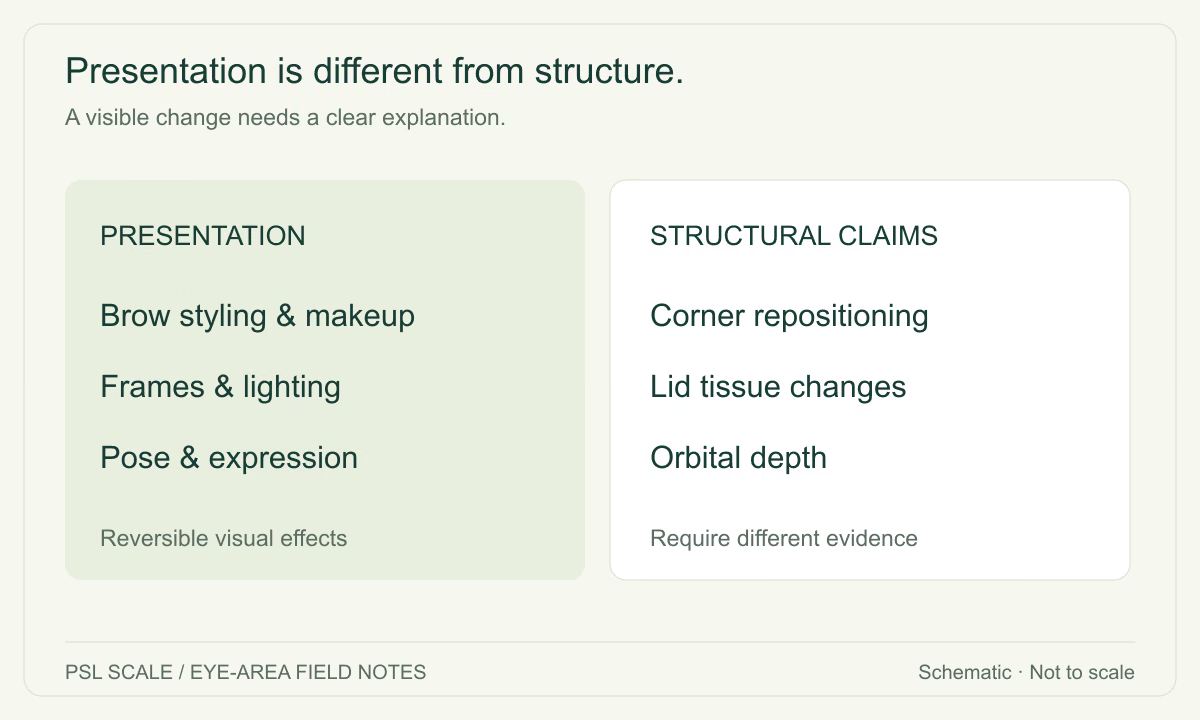
Most short tutorials show a controlled squint or an attempt to hold the lower lids higher. The visible opening becomes narrower while the expression is active. That explains an immediate change in the picture without requiring a change in the orbit or permanent repositioning of the eye corners.
If the after-photo still holds the expression, it is measuring the pose. If the lighting, camera height or brows also change, those introduce further explanations. None of that establishes what the face looks like at rest after the routine ends.
02 / FIELD NOTES
What evidence would a permanent claim need?
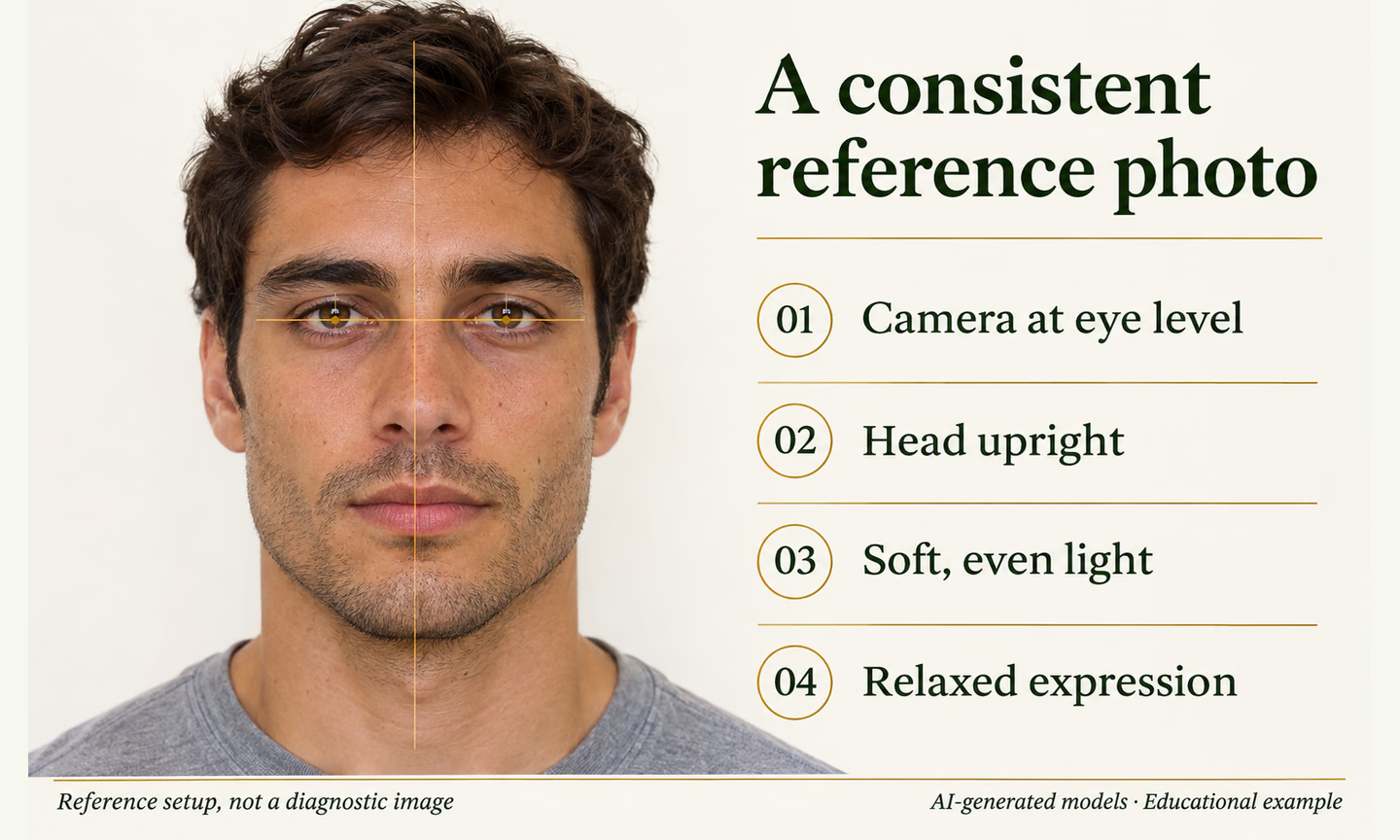
A meaningful claim would define the intended change, measure it reproducibly in relaxed conditions and show that it persists after the exercise stops. It would also need to account for camera position, expression, natural variation and other changes over time.
A compilation of dramatic selfies cannot do that. Nor does a claim become validated because a forum uses anatomical terms. Treat promises of permanent corner tilt or a deeper orbit from a home routine as unestablished rather than as a guaranteed tutorial.
An exercise can also change how someone poses for a camera without changing their resting anatomy. That can explain why a person honestly reports a stronger-looking gaze after practice while the structural claim remains unproven.
03 / FIELD NOTES
Cosmetic routines are different from clinical eye exercises
Eye-care professionals may use targeted exercises for particular coordination problems. Those have a different goal from creating a compact eyelid opening. Evidence about one goal cannot be transferred to another just because both are called eye exercises.
The American Academy of Ophthalmology notes that exercises do not prevent or cure myopia. That guidance concerns refractive vision, not an experiment proving or disproving every cosmetic eyelid claim. It is useful mainly as a reminder to ask exactly what a routine is meant to change.
04 / FIELD NOTES
Avoid turning a visual trick into eye manipulation
Do not press on the eyeballs, pull the lids repeatedly, tape the corners into position or use weights to chase an appearance. A cosmetic goal is not a reason to experiment with pressure around the eyes. Stop a routine that causes discomfort, irritation or blurred vision.
For a reversible appearance experiment, consider ordinary brow styling or removable makeup instead. The natural-options guide explains their limits, while the self-check guide helps you compare relaxed photographs consistently.
A FEW MORE ANSWERS
Frequently asked questions
Can I train myself to have hunter eyes permanently?
There is no established at-home protocol that guarantees that outcome. A practiced expression and a lasting anatomical change require different evidence.
Does mewing create hunter eyes?
Do not treat a changed selfie or an online claim as proof that a tongue-posture routine repositioned the eye corners or orbit. The hunter-eye outcome is not established by those examples.
Are hunter eyes legit looksmaxxing science?
Individual features can be described and some photo geometry can be estimated. The combined hunter label, tier rankings and guaranteed cosmetic exercise outcomes are not thereby scientifically validated.
Sources & editorial notes
Sources support the specific context described below. The hunter-eyes label itself is informal; this article has not been clinically reviewed.
- American Academy of Ophthalmology — myopia treatment
Guidance on refractive vision; it does not establish a cosmetic eyelid-training protocol.
Explore your own eye area.
Use a clear, relaxed photograph. Read the result as a photo-based description, with the limits of the image in mind.
Try the Hunter Eyes tool